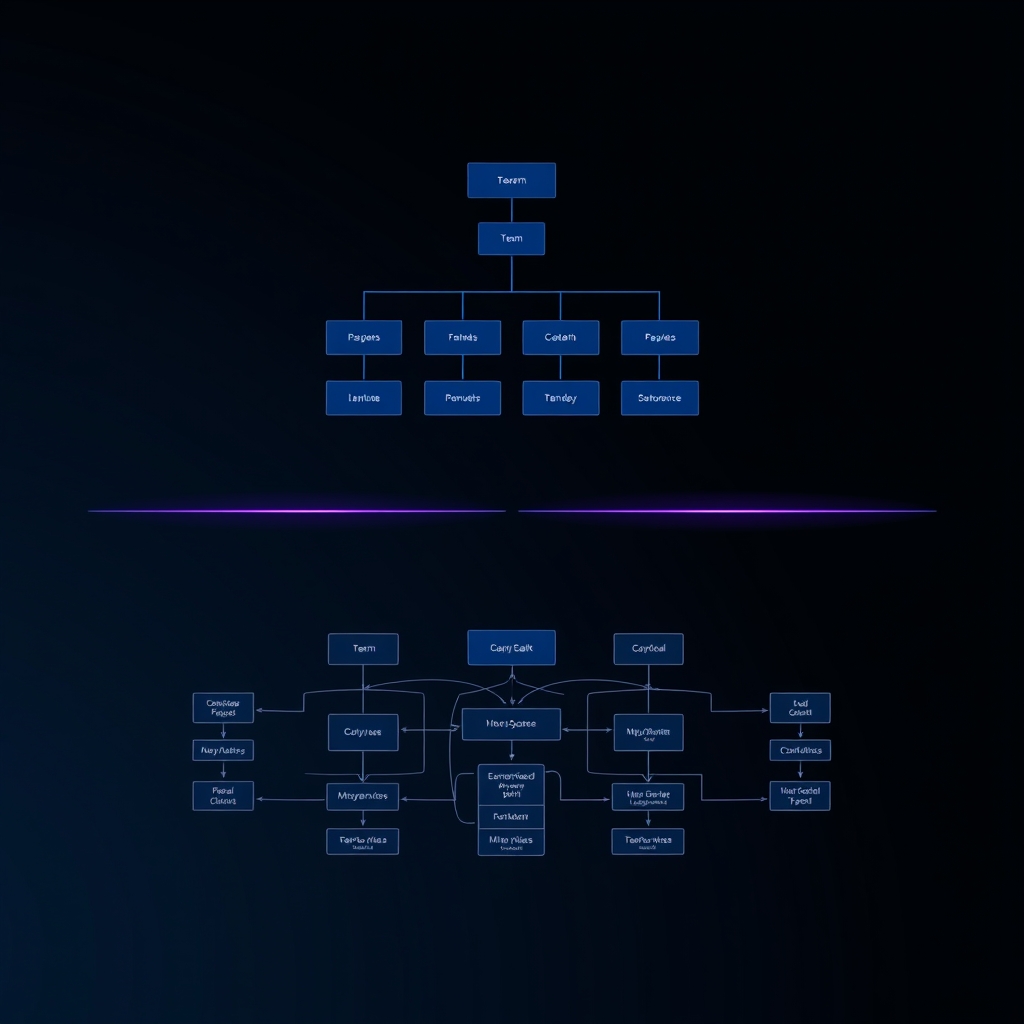
In 1967, Melvin Conway observed that organizations which design systems are constrained to produce designs that are copies of the communication structures of those organizations. Nearly six decades later, this observation remains one of the most reliably predictive laws in software engineering. It's not a suggestion. It's not a guideline. It's closer to gravity. You can't opt out of it. You can only decide whether to work with it or be surprised by it.
I've seen this play out dozens of times. A company decides to build a microservices architecture. They draw a beautiful diagram with clean service boundaries, well-defined APIs, and minimal coupling. Then they staff the project with three teams organized by technical layer -- a frontend team, a backend team, and a data team. Six months later, they don't have microservices. They have a distributed monolith with three tightly coupled layers that mirror the three teams that built them. The architecture diagram lied. The org chart told the truth.
Why It Works
Conway's Law isn't magic. It's a straightforward consequence of how humans communicate and coordinate. People on the same team communicate easily -- they share standups, Slack channels, lunch tables, and context. People on different teams communicate through formal channels -- meetings, tickets, documents, and API contracts. The ease or difficulty of communication between groups directly shapes the systems they build.
When two developers sit next to each other and work on the same codebase, they create tightly integrated components. They share abstractions. They call each other's functions directly. They build things that work well together because the communication overhead is near zero. When two developers are on different teams in different time zones, they create loosely coupled components. They define interfaces. They negotiate contracts. They build things that can work independently because the communication overhead is high and they minimize it naturally.
This isn't a failure of discipline or design. It's a natural optimization. Teams build systems that minimize the coordination cost they experience. If coordinating across a boundary is expensive, they design systems that don't require much cross-boundary coordination. If coordinating within a group is cheap, they build systems that take advantage of that tight collaboration. The system architecture converges toward the organizational structure because doing otherwise would require fighting the natural flow of information.
Communication Patterns Become API Boundaries
Here's a concrete pattern I see repeatedly. A company has a "payments team" and an "orders team." The orders service and the payments service have a clean API boundary between them. The API is well-documented, versioned, and maintained. Now look at the services within each team. The orders team owns three services -- order management, inventory reservation, and fulfillment orchestration. These three services are technically separate but deeply entangled. They share database tables. They call each other synchronously with retries and fallbacks that paper over coupling. Deploying one without the others is theoretically possible but practically never done.
Why? Because the three services within the orders team were built by people who communicate constantly. They didn't need a formal API contract because they could just walk over and ask. They didn't need versioning because they deploy in lockstep anyway. The intra-team services became a distributed monolith, while the inter-team boundary became a genuinely decoupled interface. The team boundary created the architectural boundary -- not the architecture diagram.
This is predictable. And it's why drawing service boundaries on a whiteboard without considering team boundaries is an exercise in fiction. Your actual service boundaries will be wherever your team boundaries are, regardless of what the architecture diagram says.
The Inverse Conway Maneuver
If Conway's Law means your organization structure determines your system architecture, the inverse Conway maneuver is deliberately structuring your organization to produce the architecture you want. Instead of designing the architecture and hoping the org structure cooperates, you design the org structure to make the desired architecture the natural outcome.
Want a microservices architecture with clean domain boundaries? Organize teams around business domains, not technical layers. Give each team full ownership of their domain -- frontend, backend, data, infrastructure, the entire vertical slice. The team boundary becomes the service boundary. The API contract between teams becomes the API contract between services. Conway's Law works in your favor instead of against you.
Want a platform with well-defined extension points? Create a platform team and separate application teams. The platform team builds the core, the application teams build extensions. The organizational separation forces the platform to have well-defined APIs because there's no other way for the application teams to interact with it. The tight coupling that comes from shared team membership is impossible by design.
The inverse Conway maneuver is one of the most powerful tools in a technical leader's arsenal, and it's woefully underused. Most architecture decisions are made by architects who have no influence over org structure, and most org decisions are made by managers who don't think about architectural implications. The gap between these two decision-making processes is where Conway's Law does its damage.
Team Topologies
The Team Topologies framework -- created by Matthew Skelton and Manuel Pais -- gives us a useful vocabulary for thinking about how team structure affects architecture. They identify four fundamental team types:
- Stream-aligned teams: Organized around a flow of work -- typically a business domain or product area. These are the primary value delivery teams. They own their domain end-to-end.
- Platform teams: Provide internal services that reduce cognitive load for stream-aligned teams. They build the paved roads -- CI/CD pipelines, observability stacks, database-as-a-service, deployment automation.
- Enabling teams: Help stream-aligned teams overcome obstacles and adopt new capabilities. They're consultants and coaches, not permanent service providers.
- Complicated-subsystem teams: Own components that require deep specialist knowledge -- machine learning models, cryptographic systems, real-time processing engines. They exist because the subsystem is too complex for a stream-aligned team to own incidentally.
What makes this framework powerful is that it's prescriptive about interaction modes. Stream-aligned teams should have minimal dependencies on other stream-aligned teams. Platform teams should provide self-service capabilities. Enabling teams should have a defined engagement model and exit criteria. The interaction patterns between team types shape the coupling patterns between system components.
When I see a system with unexpected tight coupling between two domains, the first question I ask isn't about the code. It's about the teams. Are the two domains owned by the same team? Do they share on-call rotations? Do they attend the same standups? Almost always, the coupling in the system mirrors the coupling in the organization. Fix the organizational coupling and the system coupling follows -- not immediately, but inevitably.
Why Reorgs Affect Architecture
Every reorg is an architecture change. Most organizations don't realize this. They reorganize teams for management reasons -- span of control, headcount efficiency, reporting structure -- without considering that they're also reorganizing the forces that shape their system architecture.
When you move a team from one reporting chain to another, you change their communication patterns. When you split a team in two, you create a new architectural boundary -- whether you planned for one or not. When you merge two teams, you remove an architectural boundary and the systems those teams own will gradually fuse together. When you create a new cross-cutting team, you create a new cross-cutting concern in your architecture.
I've watched organizations merge their "search" and "recommendations" teams for headcount efficiency. Within a year, the search and recommendation systems were deeply entangled -- shared data pipelines, shared feature stores, shared deployment processes. What were once two independent systems with clean interfaces became a coupled mess. Not because anyone planned it that way, but because Conway's Law doesn't care about your intentions.
The implication is that reorgs should involve architects, and architecture reviews should involve organizational leadership. These are not independent decisions. A CTO who approves a reorg without consulting their architecture team is approving an architecture change they haven't reviewed. A VP of engineering who designs team structure without considering the desired system architecture is designing an architecture they don't intend.
The Danger of Shared Ownership
"Everyone owns it" means no one owns it. Shared ownership of a system component is one of the most reliable predictors of architectural decay. When a service has no single team responsible for its health, evolution, and interface stability, it drifts. Decisions get made ad hoc by whoever happens to be touching it. API contracts erode because there's no one whose job it is to maintain them. Technical debt accumulates because there's no one with the authority or incentive to pay it down.
Shared ownership happens naturally when a component sits at the intersection of multiple teams' concerns. The authentication service, the notification system, the shared data pipeline -- these are the components that everyone depends on and no one wants to own. They become organizational orphans, and their architecture degrades accordingly.
The fix is explicit ownership with explicit interfaces. Every component needs exactly one team that is accountable for it. That team defines the API. That team approves changes. That team carries the pager. Other teams contribute through pull requests, not direct commits. The ownership boundary creates an API boundary, and the API boundary prevents the kind of ad hoc coupling that shared ownership enables.
This doesn't mean other teams can't contribute. It means there's a gatekeeper. And in architecture -- as in security -- gatekeepers are how you maintain boundaries.
Organizational Design as Architectural Design
The most impactful architectural work I've ever done wasn't drawing system diagrams or writing design documents. It was working with organizational leadership to restructure teams around domain boundaries. The resulting architecture improvements happened naturally over the following quarters as each team evolved their systems to match their new scope and boundaries.
This means that architects need to understand organizational dynamics, and organizational leaders need to understand systems thinking. The best technical leaders I've worked with think about team structure and system structure as two views of the same underlying design. They don't ask "what's the right architecture?" in isolation. They ask "what team structure produces the right architecture naturally?"
Some practical principles for organizational design that produces good architecture:
- Align teams to business domains, not technical layers. A team that owns the full stack of a business domain will build a cohesive, well-bounded service. A team that owns only the "database layer" will build a database layer that's tightly coupled to every service that uses it.
- Minimize cross-team dependencies. Every cross-team dependency is a potential coupling point in the architecture. If Team A can't ship without coordinating with Team B, their systems are coupled -- even if the code looks clean.
- Give teams autonomy over their internals. Teams should be able to change their implementation without coordinating with other teams. This requires stable interfaces at team boundaries -- which becomes stable APIs at service boundaries.
- Size teams for the cognitive load of their domain. A team that owns too much will create shortcuts and shared state because they can't manage the complexity within clean abstractions. A team that owns too little will create unnecessary boundaries that add overhead without benefit.
- Treat team APIs like system APIs. The way teams interact -- synchronous requests, asynchronous events, shared state -- will be reflected in how their systems interact. If you want event-driven architecture, design event-driven team interactions.
Working With the Law
You have two choices with Conway's Law. You can ignore it and be surprised when your system architecture doesn't match your design diagrams. Or you can embrace it and use organizational design as your most powerful architectural tool.
The organizations that build the best systems don't start with system design. They start with organizational design. They ask: what are the right boundaries? What are the right team sizes? What are the right interaction modes? Then they let the architecture emerge from those decisions -- guided by Conway's Law, not fighting against it.
If you want to understand a system's architecture, don't read the design documents. Look at the org chart. The org chart doesn't lie.
Conway's Law is not a bug. It's a feature -- if you know how to use it. The architects who produce the most enduring, well-structured systems aren't the ones with the cleverest designs. They're the ones who understand that the design starts with the organization, and the code follows. Every time. Whether you plan for it or not. So plan for it.