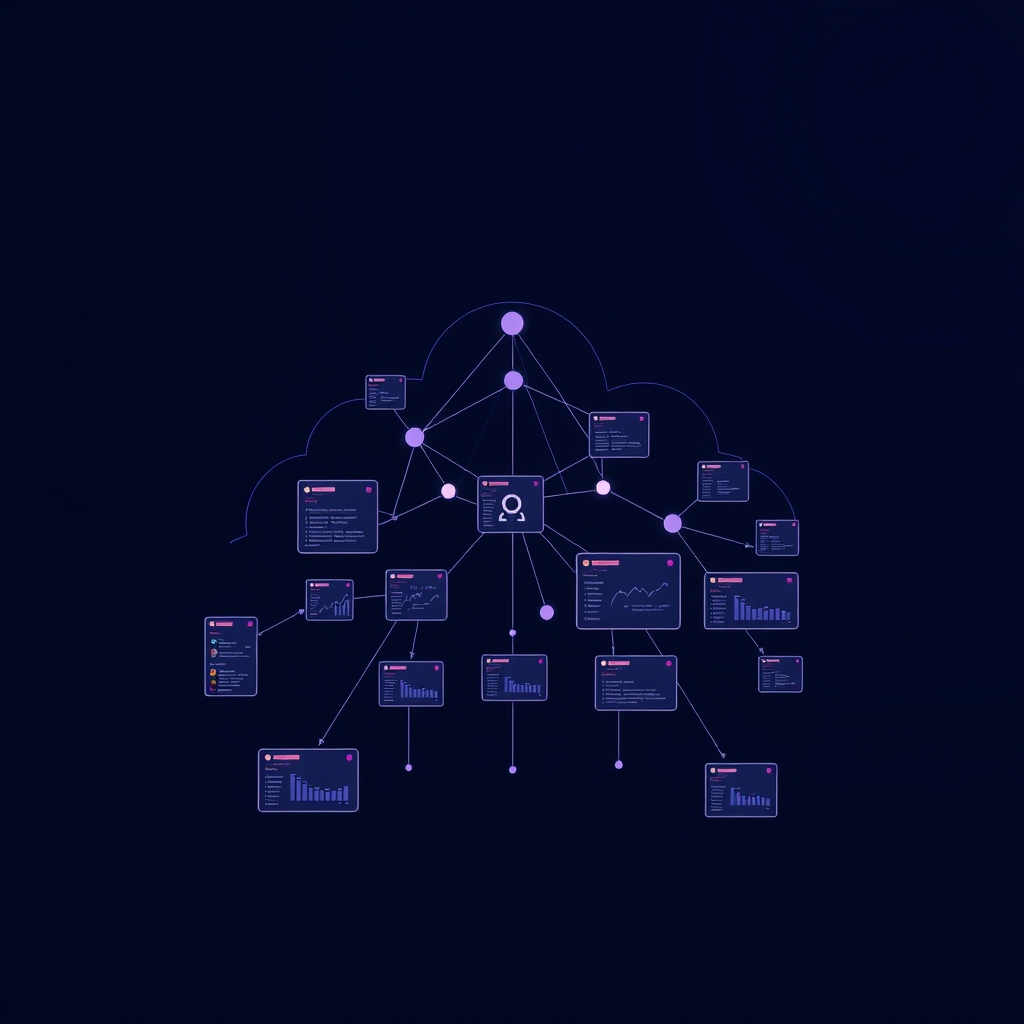
The architecture that got you to product-market fit will not get you to scale. That is not a failure of engineering. It is a success of growth.
Every startup that survives long enough faces the same inflection point: the infrastructure decisions that were exactly right eighteen months ago are now the biggest drag on the organization. The single Postgres instance that handled everything. The deploy script held together with bash and hope. The monitoring that consists of someone checking Slack. These choices made sense when speed was the only metric that mattered. They stop making sense when reliability, security, and team velocity start to matter just as much.
Recognizing this inflection point is hard because the system still works. Nothing is on fire. But the cracks are there if you know where to look, and ignoring them turns a manageable evolution into an expensive crisis.
The Organic Growth Problem
Early infrastructure is built for speed, not longevity. This is correct. When you are trying to find product-market fit, over-engineering your deployment pipeline is a waste of time you do not have. You deploy from your laptop. You SSH into the server to check logs. You store configuration in environment variables that someone set manually six months ago and nobody has documented since.
This approach works at a small scale because the entire system fits in one person's head. That person knows where the config files live, which services depend on which, and what order things need to restart in after an outage. The bus factor is one, but since there are only five engineers, the risk feels acceptable.
Then the team grows. New engineers join and spend their first two weeks asking the same questions because the answers live in someone's memory, not in documentation or code. Manual processes that took ten minutes when there was one deploy per day now consume hours because there are five deploys per day. The single server that handled peak traffic a year ago is now running at 80% capacity during normal hours. Nobody planned for this because nobody needed to. The system grew organically, and organic growth is messy.
Signs You've Outgrown Your Infrastructure
The symptoms are predictable. If you have been through this transition before, you can spot them early. If you have not, they tend to sneak up until they are impossible to ignore.
- Deployments take hours instead of minutes. What used to be a quick push now involves multiple manual steps, coordination across teams, and someone watching the process to make sure nothing breaks.
- One engineer holds all the knowledge. There is a person on the team who must be consulted for every infrastructure change. When that person is on vacation, certain changes simply do not happen.
- Scaling means buying a bigger server. Instead of distributing load, the response to traffic growth is vertical scaling. This works until it does not, and when it stops working, you have no fallback.
- Config changes require SSH access. To change a feature flag, update a connection string, or rotate a secret, someone logs into a production machine and edits a file. There is no audit trail, no review process, and no rollback mechanism.
- Nobody knows what is running in production. Ask five engineers what services are deployed and you will get five different answers. The actual state of production has drifted from whatever documentation exists, assuming documentation exists at all.
Any one of these is a warning sign. Three or more together mean you have already outgrown your infrastructure and are operating on borrowed time.
The Modernization Trap
Once the problem is acknowledged, the temptation is to fix everything at once. Rewrite the deployment pipeline. Migrate to Kubernetes. Adopt a service mesh. Implement infrastructure as code for the entire stack. Do it all in one quarter.
This is the modernization trap, and it kills projects. Big-bang migrations fail for predictable reasons. They take longer than estimated because legacy systems always have undocumented behaviors that only surface during migration. They cost more than budgeted because scope creep is inevitable when you are touching everything simultaneously. And they break things that were working, which destroys organizational trust in the modernization effort itself.
The team that spent six months on a ground-up rewrite and delivered a system with new bugs and missing features has made it harder for the next person who proposes infrastructure investment. The failure is not just technical. It is political. Stakeholders remember, and the next time someone says "we need to modernize," the answer will be "we tried that and it didn't work."
Incremental modernization is harder to plan and less satisfying to execute, but it actually works. It delivers value continuously instead of promising value at the end of a long, risky project.
The Strangler Pattern
The strangler fig pattern is the most reliable approach to infrastructure modernization. The concept is straightforward: build new capabilities alongside old ones, route traffic gradually to the new system, and decommission the legacy component only when the replacement is proven in production.
In practice, this means:
- Deploy the new service alongside the old one, both running in production
- Route a small percentage of traffic to the new service and monitor for correctness and performance
- Gradually increase the traffic share as confidence builds
- Keep the old system running as a fallback until the new one has proven itself over a meaningful period
- Decommission the old system only after the new one has handled full production load without issues
This approach requires discipline, not heroics. It is slower than a big-bang migration, but the risk at each step is bounded. If the new system has problems at 5% traffic, you route traffic back to the old system. Nobody gets paged. No customers are impacted. You fix the issue and try again.
The strangler pattern works for more than just services. You can apply it to deployment pipelines, monitoring systems, configuration management, and even databases. The principle is the same: build the new path, prove the new path, then remove the old path.
Infrastructure as Code Is Non-Negotiable
At a certain scale, you must be able to recreate your environment from code. This is not optional. It is not aspirational. It is required.
If your infrastructure cannot be version-controlled, reviewed, and tested, it is a liability. Every manual change is a configuration that exists only in production and nowhere else. Every undocumented server setup is a recovery step that will be missed during an incident. Every snowflake environment is a divergence between what you think is running and what is actually running.
Infrastructure as code means that a new environment can be provisioned from a repository. It means that changes go through pull requests, are reviewed by peers, and are applied through automation. It means that your staging environment is actually representative of production because both are built from the same code.
The tooling matters less than the practice. Terraform, Pulumi, CloudFormation, Ansible -- pick one that fits your team and use it consistently. The specific tool is a detail. The discipline of treating infrastructure as a software artifact that is versioned, tested, and reviewed is what matters.
The People Problem
Modernization is not just a technical challenge. It might not even be primarily a technical challenge. The hardest part is often organizational.
You need to convince stakeholders that systems which currently work need investment. This is a difficult argument to make because the costs of aging infrastructure are diffuse and hard to quantify. How do you put a dollar value on the fact that deployments take three hours instead of fifteen minutes? How do you measure the cost of an engineer spending 30% of their time on operational toil instead of building features?
You need teams to learn new tools while maintaining old ones. This means accepting a temporary productivity dip. Engineers who are experts in the current system become beginners in the new one. This is uncomfortable, and some people will resist it. The resistance is not irrational -- learning new tools while keeping production running is genuinely hard.
Change management is as important as architecture. Communicate the why before the what. Show incremental wins early. Make it easy for people to learn the new approach by pairing, documentation, and dedicated learning time. Do not underestimate the organizational effort required to change how a team works.
Starting Point
If you recognize these patterns in your own organization, here is a practical starting point:
- Map what you actually have. Not what you think you have, not what the architecture diagram from last year shows, but what is actually running in production right now. This exercise is almost always surprising.
- Identify the biggest pain points. Talk to the engineers doing the work. They know where the friction is. Rank the pain points by impact on team velocity and operational risk.
- Pick one subsystem to modernize first. Choose something meaningful enough to demonstrate value but small enough to complete in weeks, not months. A deployment pipeline is often a good starting point because improvements are immediately visible to the entire team.
- Define success criteria before starting. What does "done" look like? How will you measure improvement? Without clear criteria, modernization efforts drift and lose organizational support.
- Build the new path before removing the old one. Run both systems in parallel. Prove the new approach works before decommissioning the legacy one. This reduces risk and builds confidence.
Modernization is a practice, not a project. There is no finish line. The systems you build today will need to be modernized tomorrow. The goal is not to reach a final state -- it is to build the organizational muscle for continuous evolution.
Infrastructure does not age gracefully on its own. Without intentional investment, systems accumulate technical debt, operational risk, and organizational friction. The teams that handle this well are not the ones who build perfect systems on the first try. They are the ones who recognize when a system has outgrown its design, and who treat modernization as a continuous discipline rather than a one-time emergency.
Your infrastructure got you here. That is worth acknowledging. But where you are going requires something different. The sooner you start building that something, the less painful the transition will be.